Flowers, it's time for your close-up. Middle School students also explored Georgia O'Keeffe's work using a similar method as UE's, except with tempera paint. Very lovely.
Flowers, it's time for your close-up. Middle School students also explored Georgia O'Keeffe's work using a similar method as UE's, except with tempera paint. Very lovely.
Flowers, it's time for your close-up. Middle School students also explored Georgia O'Keeffe's work using a similar method as UE's, except with tempera paint. Very lovely.


 UE studied the work of American painter, Georgia O'Keeffe. I always thought flowers were pretty, but not interesting enough as an art subject. Looking at O'Keeffe's work changed my perspective. They're more than flowers; they could be landscapes, flames, organs. Her paintings are powerful because they're huge and force you to look closer and appreciate the beauty of these small objects. That's what I wanted my students to see.. the subtle color variations and intricate forms of the flowers that they wouldn't otherwise see at a quick glance. I wish we had real ones to look at, but photos were the next best thing! Each student picked a flower reference and looked for the landscape in the forms using a viewfinder. Then they colored their drawing with oil pastels. I can almost smell their sweet fragrance.


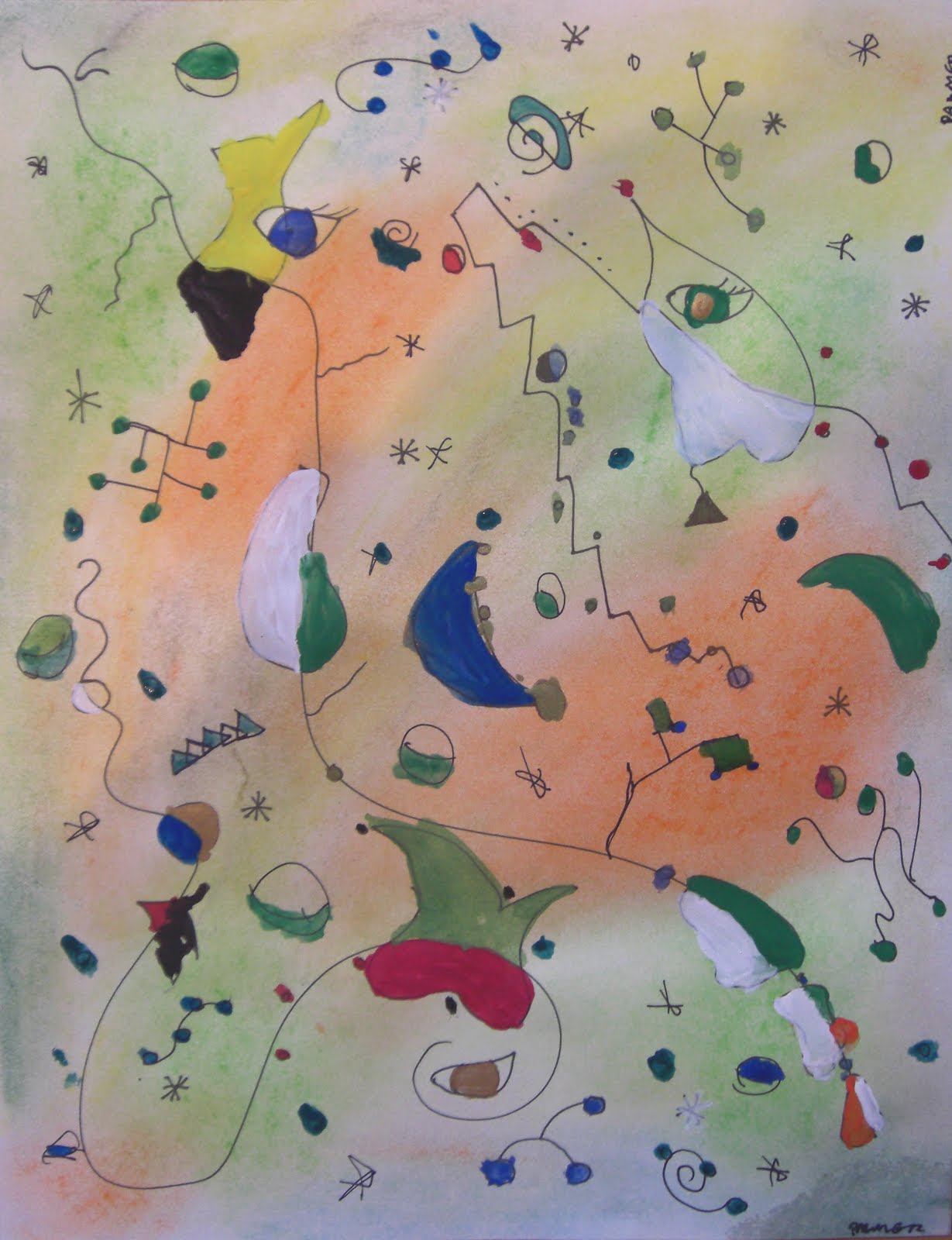

 UE studied the works of Spanish artist Joan Miro. We learned that he was a Surrealist, which was an art and literature movement based on a person's subconscious. One of the techniques that Surrealists developed in expressing the subconscious was automatic drawing, a form of drawing where the hand is allowed to move randomly across the paper, thus revealing a part of the person's psyche. For the first portion of the lesson, I had students experiment with automatic drawing while also guiding their process. Without pencils and erasers, they drew random lines in various lengths not touching each other and lines that overlapped. They added elements of the unexpected like eyes and blobs. We looked at Miro's Constellation series as our reference and drew abstracted planets and stars, making sure to fill in the composition. To create an illusion of depth, students smudged soft pastels in the background before finally painting in their constellations.


 Triangles and circles and squares oh my! Such lovely things can come out of the simplest shapes. LE has been building their castles only using geometric shapes. They first built the foundation with rectangles and squares so that it would be stable to build upward. Then they glued down their pieces, added details like windows and doors, and colored their background with oil pastels. I love how different each castle looks! UE students also did a variation of Paul Klee's Castle and Sun in the beginning of the year.


 Okay, so it's not Winter yet, but it sure feels like it! I love bare trees and whenever I see them, I think of Harry Callahan's Chicago Lake Front photograph. This was a fun project that I also did last year with LE. You can learn the technique from Crayola's website here. Students painted a gray background first and left the bottom of the paper unpainted for the snow. Then they took black tempera paint and blew it into multiple branches through a straw. They were required to place trees in the foreground, middle ground and background.
 Tommy
Tommy Amalia
 Julian
 Daniel
 Sophie


 Here are some beautiful pieces for you to enjoy! UE made weaves using colored paper and LE learned about butterfly anatomy and created butterflies out of clay and tempera paint. Key terms were symmetry, hind wings, fore wings, abdomen and thorax.